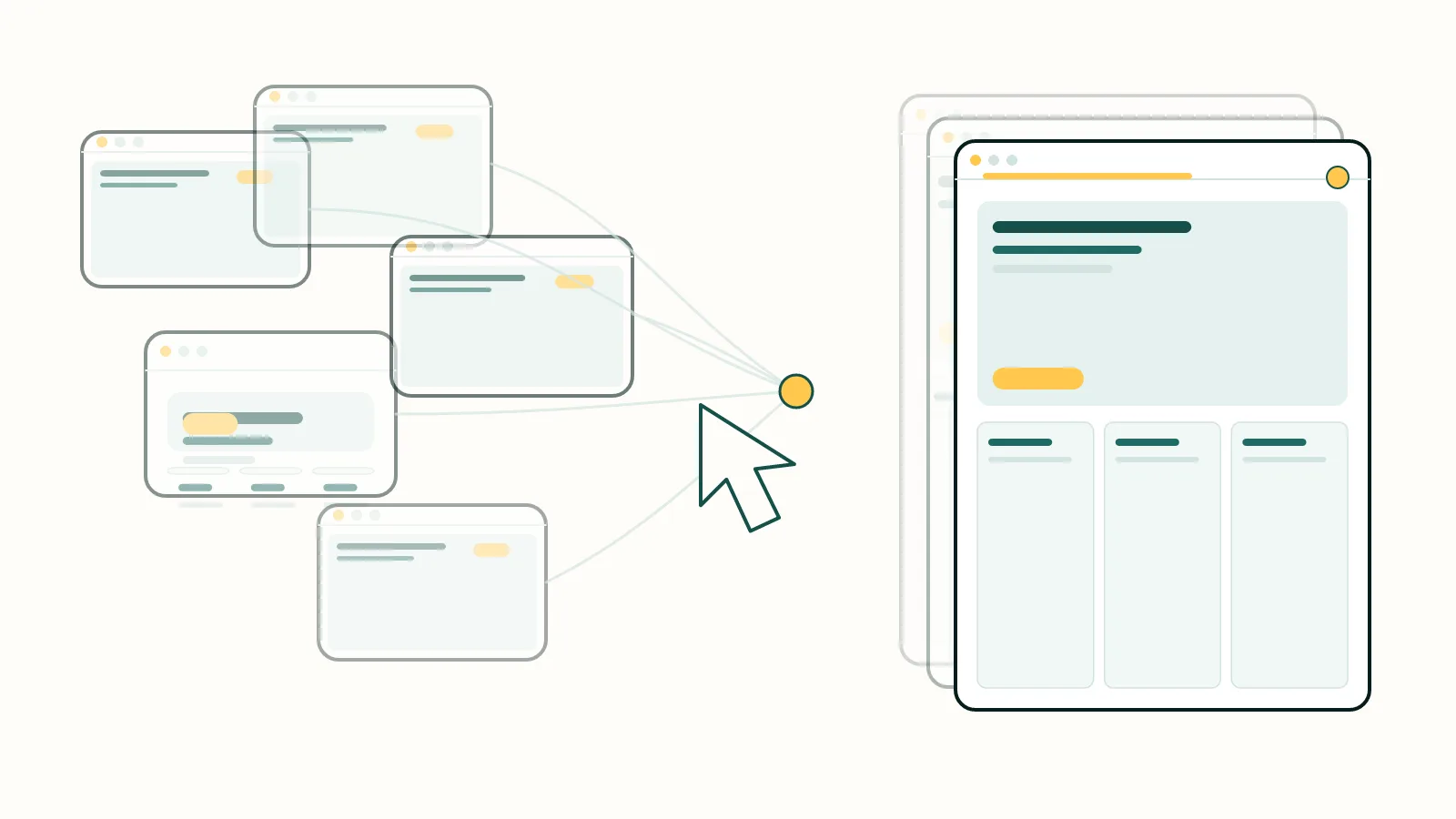
Most comparisons give a business owner two choices: ask an AI website builder for a site, or hire a designer to make one. There is a third option. An experienced team can use AI inside a controlled design and build process.
That distinction matters more than the name of the tool. A DIY AI builder asks the owner to supply the judgement. A designer supplies the judgement and does much of the production by hand. An AI-assisted agency keeps people responsible for the business decisions while using AI to organise information, explore design and handle repeatable production work.
Here is the practical comparison.
| APPROACH | USUALLY SUITS | WHAT YOU NEED TO PROVIDE | WHERE THE WORK LANDS |
|---|---|---|---|
| DIY AI website builder | A simple site when you are comfortable making the content, design and setup decisions | A useful prompt, business facts, images, time and judgement | You review, correct, publish and maintain it |
| Web designer or agency | Bespoke brand work, unusual interactions or a project where close human art direction matters | A brief, feedback and budget for the required work | The designer or team leads the process |
| AI-assisted agency | A business owner who wants a done-for-you site without losing their voice | An honest conversation, real examples, proof and timely approvals | The agency remains responsible and uses AI as part of delivery |
None is automatically the right choice. The useful question is: who is making the decisions that the software cannot make for you?
Can AI build a website for your business?
AI can generate a plausible website quickly. It can propose sections, draft copy, explore layouts, apply a design system and produce working code. The result still depends on the information and constraints it receives.
Anthropic’s current Claude Design documentation, for example, describes a tool that can take a design system, screenshots and code context, produce a working design, and pass the result to Claude Code. This is much closer to a production workflow than choosing a stock template. It also illustrates the central limitation: useful context has to come from somewhere.
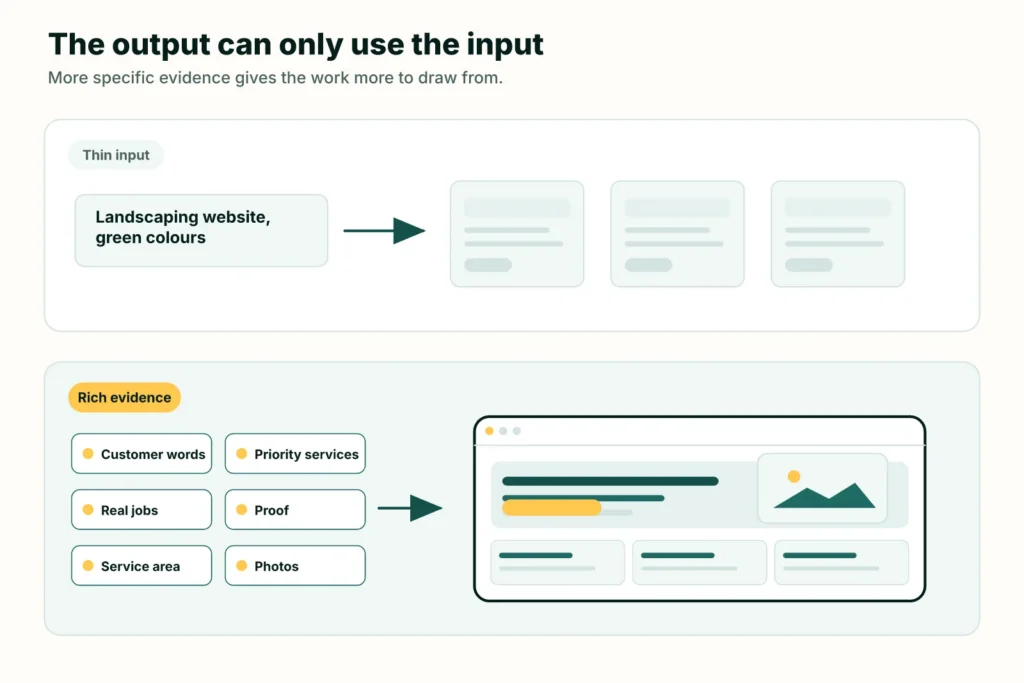
“Landscaping website with green colours” may produce a competent first screen. It says nothing about whether the business specialises in specimen trees, new subdivisions, difficult access, regular maintenance or work that nobody else wants. It does not know which jobs make money, what customers are nervous about, or what the owner will refuse to promise.
AI can arrange the facts. It cannot interview the business after the prompt has already pretended those facts do not matter.
Why do AI-built websites often sound generic?
AI-built websites sound generic when the source material contains only a business category, a few adjectives and no first-hand evidence.
The model then has to fill space with patterns that fit many businesses. The sentences may be grammatical and completely forgettable. “Quality solutions tailored to your needs” survives equally well on a builder’s site, an accountant’s site and a page selling industrial pumps. That is the problem.
We avoid it by collecting the material before generation begins:
- the owner’s explanation of the business in ordinary language;
- the services they want more of and the work they avoid;
- the questions and worries customers express before buying;
- stories about actual jobs and choices;
- service areas, photographs, reviews and qualifications that can be checked;
- realistic promises about quoting, response times and availability.
This is also sound content practice. Google says generative AI can help with research and add structure to original content. It warns against producing many pages that add no value. Google’s wider people-first content guidance asks whether a page shows first-hand expertise, offers original information and leaves its intended reader with a satisfying answer.
There is no magic “written by a human” switch that creates those qualities. Someone has to supply the experience and check the result.
How does an AI-assisted website project work?
An AI-assisted project uses the owner’s knowledge as the source of truth, then lets AI help translate it through several reviewed stages.
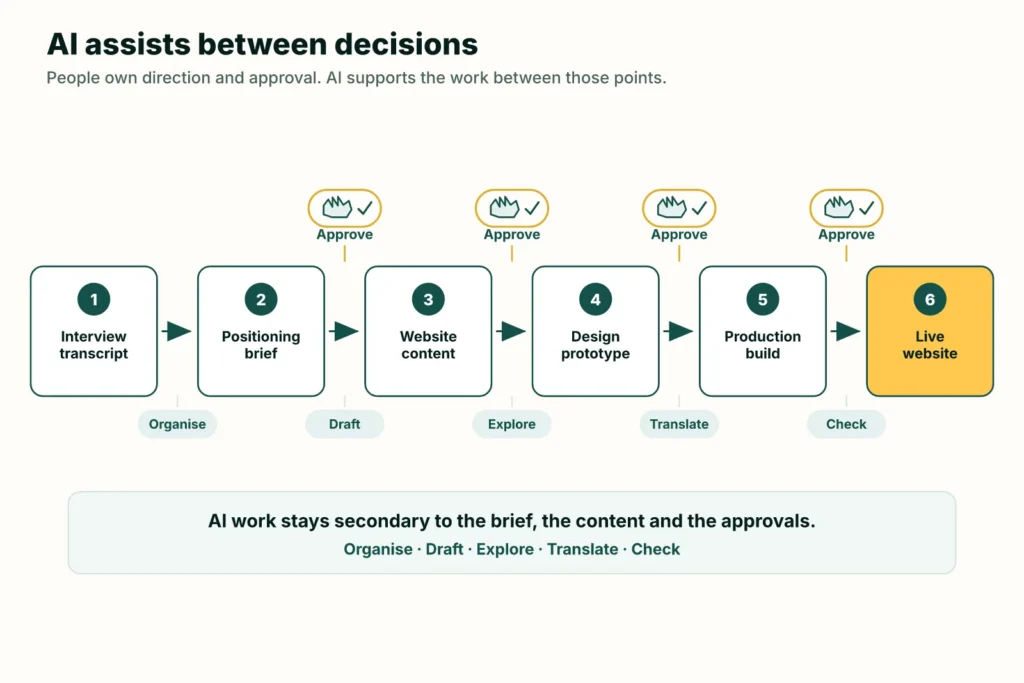
At WebAddress, the flow is:
- We interview the owner and preserve their actual language.
- AI helps organise the transcript into a positioning brief, with unknowns left visible.
- We draft the website content from the approved brief and relevant search research.
- The owner approves the claims, priorities and calls to action before design begins.
- AI design tools help turn the real content, images and constraints into a working prototype.
- We translate the approved design into the production site and test it.
- A person approves any consequential change and checks the live result.
The detailed WebAddress website design process explains what each stage produces.
AI makes it practical to carry the same source material from interview to content, from content to design, and from design into the working site. The value is continuity. The headline does not need to be reinterpreted by three people and eventually squeezed into a box designed around placeholder text.
Does AI replace the web designer?
AI changes the designer’s work. It does not remove the decisions that make the work good.
A useful designer still has to decide:
- whether the brief describes the business accurately;
- what information matters most to the customer;
- which claims have evidence and which need checking;
- whether the design gives the content the right hierarchy;
- where a familiar pattern helps and where it makes the business look generic;
- whether the production site works on a real phone;
- what should be automated and what needs a person’s approval.
AI is very good at producing options and applying a known system. It is also capable of producing a polished answer to the wrong question. The review gates keep that mistake small.
For WebAddress, the designer’s job is increasingly one of interviewing, editing, choosing, testing and translating. There is less value in rebuilding the same card by hand for the hundredth time. There is plenty of value in noticing that the card should not be there.
When is a DIY AI website builder the right choice?
A DIY AI builder is a sensible choice when the site is straightforward, the budget is tight and you are willing to make the content and technical decisions yourself.
It may suit you if:
- you need a basic online presence rather than a distinctive sales tool;
- you already have clear copy, good photographs and a simple call to action;
- you are comfortable connecting a domain, checking forms and making mobile edits;
- you expect to maintain the site yourself;
- the platform’s limits will not block likely next steps.
Before committing, check who owns the domain and content, what happens when you leave, whether you can export the site, and what the renewal price includes. A quick first draft is useful. Portability and maintenance matter over the longer term.
When is a human-led custom design process the right choice?
A human-led custom process makes sense when the visual identity itself carries unusual value, the interactions are novel, or the project has complex research and stakeholder needs.
Examples include a major rebrand, a service used by several very different audiences, or a site with behaviour that cannot be described as a familiar page and form. AI can still assist that team. It may not reduce the amount of discovery, art direction or specialist testing the project needs.
When does the AI-assisted agency model fit?
The AI-assisted agency model fits owners who know their work and want someone else to turn that knowledge into a professional, supported website.
This is common among trades and local service businesses. The owner can explain a good job in detail, but has no wish to learn a design tool, write five pages about themselves or diagnose why a form email disappeared. Their half-hour is best spent telling us what customers care about. We can do the translation and remain responsible for the result.
What should you ask an AI website provider?
Ask questions that reveal the process behind the demonstration:
- What information do you collect before generating the first design?
- Who checks the facts and promises in the copy?
- Will I approve the positioning and words before the build?
- Are real photographs and customer language used, or does the tool create substitutes?
- Who checks the site on a phone and tests the contact form?
- What do I own, and can I move it elsewhere?
- What happens when my business changes after launch?
- If AI makes a wrong change, how is it found and reversed?
A provider with a real process should be able to answer these plainly. “Our AI handles everything” is an answer too, just not a reassuring one.
WebAddress is RimuHosting’s website design and managed hosting service.
If you want the speed of current tools and a team that still takes responsibility for the details, tell WebAddress what you do. We will start with the business, show you the words and design, then build and look after the site.
If you are preparing for that conversation, here are the 12 questions we ask before designing a website.